Top Desert Festivals in America: The 2026 Operational Audit
The intersection of extreme topography and contemporary culture has redefined the American festival landscape. In the 2026 season, the arid basins of the Southwest and the high-desert plains of the Great Basin are no longer merely backdrops for music; they are active participants in a high-stakes logistical drama. To analyze the premium tier of these events is to study a complex synthesis of temporary urbanism, resource management, and environmental resilience.
The current cultural momentum toward desert venues is driven by a desire for “Atmospheric Isolation.” As metropolitan festivals face increasing noise ordinances and spatial constraints, the desert offers an expansive, “clean-slate” architecture that allows for larger-scale installations and immersive, 24-hour programming. However, this freedom comes with a significant “Infrastructure Tax”—the requirement to build every utility, from water grids to cellular nodes, in a terrain that is fundamentally hostile to human density.
For the modern attendee and producer, the value of these experiences has shifted from simple entertainment to “Survivability Excellence.” A world-class desert event is now judged by its ability to maintain a safe, climate-controlled, and acoustically pure environment against the volatility of the landscape. Success in this sector requires moving beyond the “Party in the Dust” mentality and toward a rigorous framework of systems engineering and ecological stewardship.
This pillar article serves as a technical and editorial deconstruction of the most significant arid-land gatherings in the United States. By examining the historical shift from counter-culture experiments to billion-dollar economic engines, and identifying the structural vulnerabilities inherent in these environments, we provide a definitive reference for understanding the “Top Tier” of the desert circuit.
Understanding “top desert festivals in America.”
To accurately define the top desert festivals in America, one must move past the superficiality of ticket sales and analyze “Operational Sovereignty.” A common misunderstanding in the mainstream media is that a desert festival is simply a standard festival with more dust. In reality, the “Desert Delta”— the gap between a standard urban site and an arid site—represents an exponential increase in logistical complexity.
From a structural perspective, a premier desert festival is an ecosystem where three forces are in constant tension:
-
The Resource Force: The ability to transport and maintain a 24/7 supply of potable water, medical-grade cooling, and waste management in a location with zero permanent utilities.
-
The Thermal Force: Managing the “Diurnal Swing”—where a site may experience 40°C temperatures at 2:00 PM and 5°C at 2:00 AM, requiring two entirely different sets of infrastructure and medical preparations.
-
The Spatial Force: The utilization of the “Infinite Horizon” to create stages and art that would be physically impossible in a city, while maintaining a safe “Egress Buffer” for emergency services.
Oversimplification in this field often centers on “Aesthetic Bias.” Many attendees choose festivals based on the visual “Playa” or “Red Rock” aesthetic without understanding the “Physical Cost” of that beauty. A top-tier event is one where the production team has successfully “Hardened” the environment so that the attendees’ focus remains on the culture, not the basic struggle for hydration or shelter.
Deep Contextual Background: The Arid Evolution
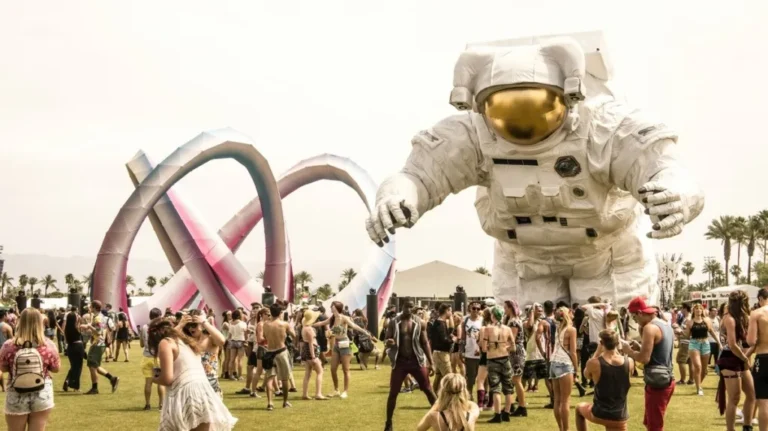
The history of American desert festivals is a narrative of “Radical Scaling.” The movement began in the late 1980s and early 1990s as a rejection of the corporate, stadium-based concerts of the era. The Black Rock Desert and the Indio Valley became sanctuaries for “Temporary Autonomous Zones”—spaces where the lack of oversight allowed for experimental art and non-linear performance schedules.
The 1999-2004 period served as the “Institutional Pivot.” This was when the “Boutique Desert” model—exemplified by early Coachella and Joshua Tree gatherings—demonstrated that the desert could host mainstream, high-fidelity sound systems without the chaotic “Wild West” risks of earlier eras. This transition introduced the “Duty of Care” as a central logistical pillar, forcing organizers to invest in professional security, medical triage, and dust-mitigation technology.
By 2026, the desert festival will have become a “Logistical Fortress.” We now operate in an environment where sites are mapped with LiDAR, weather is monitored by on-site meteorologists, and crowd flow is analyzed via real-time heatmaps. The evolution has moved from “Bringing People to the Desert” to “Building a Smart City in the Desert.”
Conceptual Frameworks and Mental Models
1. The “Closed-Loop” Survival Model
This framework posits that a desert festival is a “Life Support System.” Every input (water, fuel, food) must be perfectly balanced with every output (gray water, trash, exhaust). A premier festival is judged by its “Leakage Rate”—how much of its footprint it fails to recover or manage effectively.
2. The “Thermal Resilience” Matrix
This mental model categorizes infrastructure not by its function (Stage, Tent, Bar), but by its ability to withstand temperature extremes. Every piece of hardware—from LED panels to generator cooling fans—must be rated for the specific “Desert Delta” of that location.
3. The “Infinite Scale” Illusion
This identifies the psychological risk of the desert’s vastness. Because there are no walls, organizers often over-expand the site, leading to “Transit Fatigue” where attendees spend 40% of their time walking between stages. Excellence is found in “High-Density Pockets” within the vast landscape.
Key Categories of Premier Desert Festivals
| Category | Primary Examples | Defining Logic | Logistical Trade-off |
| The Institutional Mega | Coachella, Stagecoach | High-fidelity; high infrastructure; permanent-site hybrid. | High cost vs. maximum safety/comfort. |
| The Radical Temporary | Burning Man | 100% temporary; non-commercial; high self-reliance. | Extreme immersion vs. high human risk. |
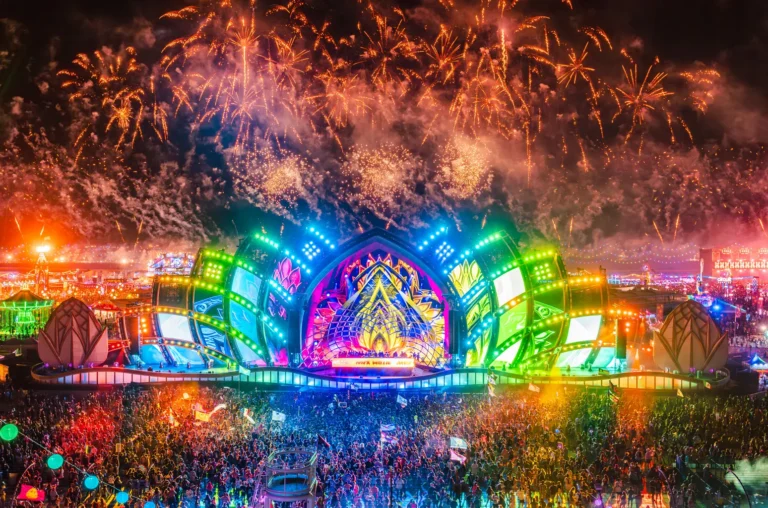
| The Neon Speedway | EDC Las Vegas | High-density urban-desert hybrid; 24-hour infrastructure. | Maximum spectacle vs. high noise/light fatigue. |
| The High-Desert Boutique | Joshua Tree, FORM Arcosanti | Intimate scale; landscape-specific architecture. | High cultural fidelity vs. limited capacity. |
| The Red Rock Gateway | Goldrush, Gem & Jam | Proximity to urban hubs; transit-heavy. | High accessibility vs. “Sanitized” desert feel. |
Detailed Real-World Scenarios
Scenario A: The “White-Out” Dust Response
A “Top Tier” festival in Nevada faces a sudden 60mph dust storm during a peak set.
-
The Logic: Instead of a chaotic shutdown, the “Hardened” production utilizes “Weather Thresholds.” Stages are weighted for 80mph, and LED walls are placed on “Low-Profile” hydraulic mounts.
-
The Outcome: Sound is paused, but visual “Safety Beacons” remain active. The crowd is held in “Safe-Zones” rather than evacuated, preventing a panic in zero-visibility conditions.
Scenario B: The “Flash-Flood” Delta
An Arizona festival site in a dry wash experiences a sudden upland storm.
-
The Logic: Using “Topographical Modeling” during the planning phase, the primary stages were built on 4-foot “Hydraulic Risers” above the historical flood line.
-
The Outcome: The site remains operational while the surrounding low-ground is naturally drained, preserving the multi-million dollar AV equipment.
Planning, Cost, and Resource Dynamics
The “Desert Tax” is a reality of the P&L statement. To provide a standard experience in a remote desert, the OpEx is typically 40-60% higher than a metropolitan site.
Estimated “Desert Infrastructure” Cost Variance
| Resource | Metropolitan Cost | Desert Remote Cost | Primary Driver |
| Potable Water | $0.02 / gal | $1.80 / gal | Trucking, storage, filtration. |
| Power Grid | Grid Tie-in | $150,000 (Generators) | Fuel haulage, N+1 redundancy. |
| Sanitation | Local Sewer | $85,000 (Pump/Haul) | Bio-hazard logistics in heat. |
| Dust Mitigation | $0 | $25,000 (Polymers) | Road treatment and maintenance. |
| Medical Staff | On-call / Local | $200,000 (On-site ER) | Trauma-level desert triage. |
Tools, Strategies, and Support Systems
-
LiDAR Site Mapping: Used to identify natural “Wind Corridors” and “Drainage Basins” before stage placement.
-
Parametric Weather Insurance: Payouts triggered automatically by wind speed or heat indices, ensuring fiscal survival even if a day is cancelled.
-
Satellite “Mesh” Nodes: Providing dedicated bandwidth for production and medical teams when local towers are saturated.
-
Acoustic “Topography” Design: Using the natural rise and fall of the desert floor to create “Sonic Valleys” that prevent stage bleed.
-
RFID Hydration Tracking: Monitoring “Water Station Throughput” in real-time to prevent station outages during heat spikes.
-
“Cooling Hub” Architecture: Shipping containers converted into high-capacity AC hubs that can drop body temperatures by 10 degrees in 5 minutes.
-
Soil-Binding Polymers: Non-toxic chemicals sprayed on primary arteries to prevent the “Dust Haze” that causes respiratory and AV failure.
Risk Landscape: The Taxonomy of Arid Failure
-
The “Dehydration Lag”: The delay between an attendee feeling thirsty and the onset of heatstroke. A failure in the “Fluid Supply Chain” leads to a compounding medical crisis that can overwhelm on-site triage.
-
The “Grounding” Error: High-desert static electricity and lightning risks. Improperly grounded stages in a flat desert basin are magnets for “Direct Strikes.”
-
The “Logistical Black-Hole”: A single breakdown on a one-lane desert access road. If the primary “Artery” is blocked, the entire festival’s food, water, and emergency egress are paralyzed.
Governance, Maintenance, and Long-Term Adaptation
-
The “Leave No Trace” Audit: For the top desert festivals in America, the “MOOP” (Matter Out Of Place) sweep is not an afterthought; it is a multi-week technical operation involving line-sweeps and magnetic rakes.
-
Parametric Review Cycles: Using historical data to move event dates. If a 10-year trend shows a heat increase in late April, the premier festival shifts to mid-March to preserve attendee safety.
Measurement, Tracking, and Evaluation Metrics
-
“Heat-to-Incident” Ratio: Tracking how many medical interventions occur for every degree above 35°C.
-
“Resource Buffer” Percentage: The amount of water/fuel remaining at the end of the event. A “Top Tier” event should never drop below a 25% reserve.
-
“Acoustic Integrity” Score: Measuring decibel spill between stages to ensure the “Artist Narrative” remains pure.
Common Misconceptions
-
“The desert is space.” No. It is a highly regulated and ecologically fragile environment that requires millions in permitting and restoration.
-
“It’s always hot.” The “Diurnal Swing” can lead to hypothermia in a desert at night if infrastructure is only planned for the day.
-
“You can just use normal gear.” Dust is an abrasive that destroys “Urban-Rated” electronics and moving parts in 48 hours.
-
“More water stations solve the problem.” “Throughput” is what matters. 100 stations with low pressure are less effective than 20 stations with high-volume manifolds.
-
“It’s cheaper because land is cheap.” The land is a small cost; the “Logistical Bridge” to that land is the highest expense in the industry.
-
“Desert festivals are unsustainable.” Modern desert events are often “Laboratories of Sustainability,” testing solar grids and water recycling in extreme conditions.
Conclusion
The evaluation of the top desert festivals in America is a study in “Resilient Sovereignty.” As we move further into the 2020s, the festivals that will define the era are those that respect the “Biological Limits” of the landscape while utilizing its “Spatial Freedom.” Success is found where the high-stakes engineering of a temporary desert city meets the raw, visceral energy of live performance. The premier desert gathering is not just a party; it is a triumphant exercise in human organization against a landscape that demands absolute respect.