Best Electronic Festivals United States: The 2026 Operational Guide Focus
The landscape of American electronic music has undergone a structural transformation over the last decade, evolving from a fragmented underground movement into a multi-billion-dollar pillar of the global entertainment economy. In 2026, the domestic circuit is characterized by a high degree of technical sophistication, where the “Best” is no longer defined merely by the presence of Tier-1 headliners. Instead, the metric for excellence has shifted toward the “High-Fidelity Environment”—a synthesis of advanced acoustic engineering, immersive visual narratives, and a logistical infrastructure capable of supporting temporary cities for three to five days at a time.
The complexity of these events is often obscured by their aesthetic surfaces. Behind the synchronized LED arrays and the pyrotechnic sequences lies a rigorous municipal operation. To host a premier electronic music event in the United States today is to manage a high-stakes convergence of municipal permitting, specialized labor management, and a volatile global supply chain for audio-visual hardware. As ticket prices reach historic parity with luxury travel, the attendee’s expectation has transitioned from simple participation to a demand for “Experiential Sovereignty”—the desire for a frictionless, safe, and acoustically pure environment that justifies the significant personal and financial investment.
Navigating this ecosystem requires an analytical lens that looks past the marketing “After-Movies” to examine the underlying structural integrity of these gatherings. Whether it is a metropolitan “Super-Festival” utilizing a city’s existing infrastructure or a “Remote-Destination” build in a desert or forest basin, the successful event must balance the creative “Energy of the Mass” with the cold reality of a balance sheet that starts deeply in the red months before the first gate opens.
This pillar reference serves as a technical and editorial deconstruction of the most significant electronic gatherings in the United States. We will move beyond the superficial “Top 10” lists to explore the historical evolution, the conceptual models of crowd behavior, and the risk landscapes that define the modern American circuit. The objective is to provide a definitive roadmap for those attempting to understand how specific events achieve topical authority and long-term sustainability in an increasingly crowded and scrutinized market.
Understanding “best electronic festivals united states”
To accurately assess the best electronic festivals united states, one must first discard the notion that “Popularity” is a synonym for “Quality.” In the current market, “Best” is a multi-dimensional metric that accounts for “Acoustic Fidelity” and “Logistical Grace.” A common misunderstanding among casual observers is that a festival’s quality is solely a reflection of its talent budget. However, a multi-million dollar lineup cannot compensate for a site that suffers from “Sonic Bleed” or a logistics plan that leaves attendees in four-hour parking queues during a heatwave.
From a structural perspective, a premier electronic festival is an ecosystem where three primary forces are in equilibrium:
-
The Technical Force: The ability to deploy sound systems that can handle the specific sub-bass requirements of modern electronic genres across massive outdoor spaces without distortion.
-
The Logistical Force: The “Invisible Hand” of management—ensuring that water, shade, sanitation, and safety are so well-integrated that the attendee never has to consciously seek them out.
-
The Curatorial Force: Moving beyond the “Big-Room” hits of the previous decade to present a diverse range of sub-genres, from melodic techno and house to experimental bass and hardstyle, reflecting the specialized tastes of a 2026 audience.
Oversimplification in this sector often centers on “Visual Bias.” Many festivals are ranked highly based on their stage designs and pyrotechnics, despite suffering from “Operational Decay” or “Crowd Saturation.” A contemporary analytical approach prioritizes events that have adapted to the modern requirements for “Digital Ingress” (biometric or RFID entry) and “Climate Resilience.” True excellence is found where the high-stakes engineering of the production remains invisible to the participant, allowing the music to remain the central focus.
Contextual Evolution: From Rebellious Underground to Civil Engineering
The history of American electronic festivals is a trajectory from “Illegal Occupation” to “Municipal Partnership.” In the late 1980s and early 90s, the “Rave” was defined by its transience and its friction with authority. These were low-infrastructure events where the lack of planning was a cultural feature. The “Warehouse Era” relied on improvisational power grids and word-of-mouth location sharing, often resulting in systemic failures or police intervention.
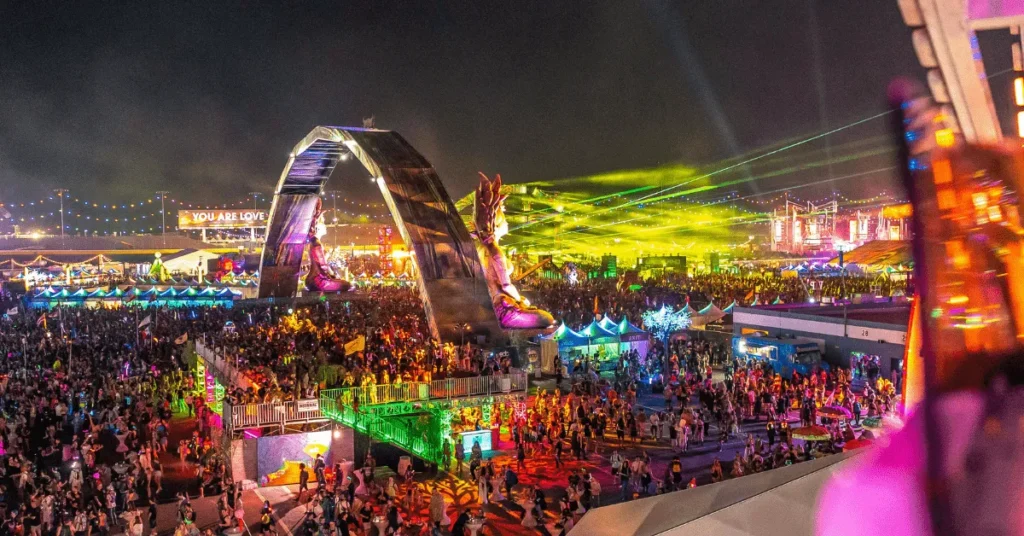
The mid-2000s marked the “Commercial Transition.” This era saw the rise of the “Mega-Festival”—events that brought the production values of stadium rock to the electronic space. This period introduced the “Mojo” barrier, the professional line-array speaker, and the tiered VIP ticket. While safety and fidelity improved, a “Homogenization of Experience” occurred, where many festivals began to look and sound identical regardless of their city.
By 2026, the industry has transitioned into the “Resilience and Specialization” era. Festivals are no longer just music events; they are “Brand Municipalities.” They utilize high-fidelity spatial data to map crowd flow and “Acoustic Modeling” to ensure that the Sound Pressure Level (SPL) is consistent without violating municipal noise ordinances. The evolution has moved from “surviving the night” to “optimizing the second.” The focus is now on “Frictionless Utility”—the idea that every physical or digital interaction should be instantaneous and intuitive.
Conceptual Frameworks for Electronic Event Mastery
1. The “Acoustic Sovereignty” Model
This framework dictates that each stage must exist in a “Sonic Vacuum.” In poorly planned festivals, the bass from the Dubstep stage often bleeds into the Melodic House stage. Excellence is achieved through “Topographical Sound Design”—using hills, shipping containers, or specialized directional speaker arrays to ensure that the “Audio Narrative” of one stage never compromises another.
2. The “Pulse Surge” Logistics Theory
Electronic festivals experience unique “Mass Migration” patterns compared to other genres. When a major headliner ends, tens of thousands of people move simultaneously.
3. The “Experience-per-Decibel” Metric
This model suggests that high volume is not a substitute for high quality. A premier festival focuses on “Clarity” rather than “Raw SPL.” This involves sophisticated “Sound Processing” and “Time-Alignment” of speakers across the field to ensure that a guest at the back of the crowd hears the same nuanced frequency range as a guest at the front.
Key Categories of Premier Festivals and Strategic Trade-offs
The American electronic circuit is segmented by “Operational Philosophy.” Each category offers a specific set of trade-offs for the attendee and the organizer.
| Category | Primary Example | Strength | Structural Trade-off |
| Metropolitan Institutional | Ultra Miami, ARC | Infrastructure; Urban Access. | 10:00 PM Curfews; Split Venues. |
| The “Speedway” Mega | EDC Las Vegas | 24-Hour Culture; Scale. | Heat Risks; High Transit Friction. |
| The “Nature” Immersive | Electric Forest, Elements | High Social Cohesion; Scenery. | Sanitation Fatigue; Weather Exposure. |
| Boutique Curatorial | Movement (Detroit) | Deep Genre Integrity. | Limited “Mainstream” Appeal; Scale. |
| Hard-Genre Specialty | Lost Lands | Hyper-Targeted Community. | “Echo Chamber” Lineups; Crowding. |
| Cruise/Destination | Holy Ship!, Groove Cruise | Total Logistical Control. | High Entry Price; Extreme Scarcity. |
Detailed Real-World Scenarios
Scenario A: The “Rain-Out” Resilience
A forest-based festival faces a 3-inch rainfall on the second day.
-
The Error: To save $20,000, the organizer skips the “Gravel Foundation” for the primary walking paths.
-
The Outcome: The site becomes a mud-trap, vehicles are bogged down, and the fire marshal closes the event.
-
The Best Path: The “Top Tier” festivals utilize “Geotextile Underlays” and pre-positioned drainage pumps, ensuring the show continues regardless of the mud.
Scenario B: The “Headline Blackout”
A main stage power grid fails during the final set of the night.
-
The Logic: Premier electronic festivals use “N+1 Redundancy.” For every primary generator, there is a “Shadow Generator” running in sync.
-
The Outcome: If the first unit fails, the second unit takes the full load in under one millisecond, preventing the silence that often leads to crowd agitation and potential unrest.
Planning, Cost, and Resource Dynamics
The economics of a premier electronic festival are asymmetric. A $10,000 mistake in the planning phase—such as miscalculating the “Internet Uplink” requirements for the POS system—can lead to a $1,000,000 loss in beverage revenue if the credit card readers go dark during a peak hour.
Estimated Operational Allocation (Daily Site of 40,000 Attendees)
| Category | Percentage of OpEx | Success Metric |
| Hardware Production | 25% | 0% Technical Downtime. |
| Safety & Medical | 15% | <10 min Response Time. |
| Talent & Booking | 35% | Ticket Sell-out Rate. |
| Logistics & Sanitation | 15% | “Clean-to-Ground” Rating. |
| Compliance & Permits | 10% | Zero Municipal Fines. |
The Opportunity Cost of “DIY” Production: Many mid-tier festivals try to save money by using local, non-specialized sound companies. However, the “Cost of Poor Audio” is high. Electronic fans are technically literate; if the sub-bass is “muddy,” they will not return. In this sector, “Premium Hardware” is a marketing asset, not just a line item.
Tools, Strategies, and Support Systems
-
LiDAR Crowd Modeling: Mapping the site in 3D to identify “Density Spikes” before they become “Crushes.”
-
Telemetry-Driven Power: Generators that report fuel levels and phase-load to a central command center in real-time.
-
Parametric Weather Insurance: Payouts triggered by objective data (wind speed or rainfall), ensuring the festival stays solvent even if a day is lost.
-
“Mesh” Communication Networks: Private, encrypted radio and Wi-Fi channels for production staff that function even when the public cellular network is saturated.
-
Acoustic “Null-Zones”: Using phase-cancellation to create pockets of relative silence for staff and medical tents within a high-dB environment.
-
RFID Cashless Ecosystems: Reducing “Transaction Latency” to under 3 seconds per purchase, maximizing concession revenue while minimizing lines.
-
Biometric Ingress: Speeding up entry to under 10 seconds per person, preventing the “Front Gate Surge” that causes security friction.
Risk Landscape: The Taxonomy of Production Failure
-
The “Digital Deadzone”: Failing to install a dedicated fiber backbone. When 50,000 people arrive and saturate local towers, the production team loses the ability to communicate, leading to a breakdown in coordination.
-
The “Sanitation Threshold”: The point where the “Sanitation Ratio” (toilets per person) fails. This is the primary predictor of attendee dissatisfaction. Once wait times exceed 10 minutes, the “Social Temperature” of the crowd rises.
-
The “Sub-Bass Violation”: Exceeding municipal noise ordinances for low-frequency sound. This often leads to immediate, non-negotiable shutdowns by local police, even if the “Total Volume” is within legal limits.
Governance, Maintenance, and Long-Term Adaptation
Stability in a festival brand is maintained through “Zero-Tolerance” auditing.
-
The “Hot Wash” Protocol: A mandatory review 24 hours post-event where every lead identifies “The Near Misses”—things that almost failed but didn’t. This is the only way to avoid repeating common festival planning mistakes in the next cycle.
-
Environmental Stewardship: Moving from “Waste Removal” to “Zero-Waste Circularity.” In 2026, the “Best” festivals compost 90% of their organic waste on-site.
-
Vendor Stewardship: Maintaining a “Damage Ledger” for all rented hardware. Returning gear in poor condition leads to higher “Risk Premiums” from vendors in following years.
Measurement, Tracking, and Evaluation Metrics
-
“Egress Velocity”: The speed at which the site can be safely cleared. A successful plan clears the main area in under 30 minutes for every 10,000 attendees.
-
“Queue-to-Entry” Time: If the average attendee waits more than 45 minutes, the ingress architecture has failed.
-
“Acoustic Integrity” Score: Measuring frequency response across the entire field to ensure the “Artist Narrative” remains pure.
Common Misconceptions
-
“The lineup is the only thing that sells tickets.” In 2026, the “Experience Brand” is more powerful. Fans follow the festival’s reputation for sound and safety as much as the artists.
-
“Louder is better.” Electronic fans value “Clarity.”
-
“Insurance is just for rain.” Modern insurance covers everything from “Terrorism Liability” to “Artist Non-Appearance” and “National Grid Failure.”
-
“VIP is just a better view.” In the premier tier, VIP is about “Logistical Autonomy”—private transit, zero-queue bathrooms, and dedicated power for mobile devices.
-
“Sustainability is just for PR.” Proper waste management and solar integration significantly reduce “Haulage Fees” and “Fuel Costs,” making the festival more profitable.
-
“Security is for enforcement.” High-tier festivals use “Stewardship-Style” security focused on safety and medical assistance rather than confrontation.
Conclusion
Determining the best electronic festivals united states is an exercise in analyzing “Logistical Grace.” As the American market continues to mature, the festivals that will endure are not those with the largest marketing budgets, but those that respect the “Biological and Technical Limits” of the experience. The definitive American festival is a resilient, adaptive, and highly tuned ecosystem that provides a safe harbor for the collective experience.