Common Festival Planning Mistakes: The 2026 Technical Audit
The orchestration of a large-scale festival is a study in temporary infrastructure and high-stakes logistics. It is an industry where the margin for error is razor-thin, and the consequences of a systemic failure are magnified by the density of the participants and the visibility of the platform. For the modern event producer, the challenge is no longer merely conceptualizing a creative theme; it is managing a multi-million-dollar operation that must function with the precision of a municipality, created and dismantled within a matter of days.
The current landscape of 2026 presents a unique set of pressures. As material costs remain volatile and labor markets for specialized technical roles tighten, the room for “improvisational management” has vanished. A festival that is planned with a “wait-and-see” philosophy toward critical infrastructure—be it power grids, sanitary systems, or crowd ingress—is a festival destined for a public and costly failure. Success in this field requires a move from creative promotion to rigorous systems engineering.
Furthermore, the “social velocity” of the modern era means that any logistical friction is instantly broadcast, turning a minor bottleneck into a brand-threatening crisis. To navigate this, one must move beyond surface-level checklists and engage with the underlying mechanics of event stability. A definitive understanding of where most festivals fail—not in their artistic vision, but in their operational foundation—is the primary requirement for long-term survival in the experiential economy.
This pillar article serves as a technical deconstruction of the most frequent points of failure in the industry. By examining the historical evolution of event risks, applying cognitive frameworks to logistics, and identifying the structural vulnerabilities that lead to systemic collapse, we provide a strategic reference for producers aiming to build resilient, sustainable, and safe large-scale experiences.
Understanding “common festival planning mistakes”
To accurately deconstruct common festival planning mistakes, one must look past the superficial symptoms and identify the “Root-Cause Architecture.” A common misunderstanding in the field is that a festival fails because of a single catastrophic event—such as a storm or a headliner cancellation. In reality, most failures are the result of “latent conditions”: poor procurement choices, inadequate site surveys, or fragmented communication hierarchies that remained invisible until a stressor was applied.
From a multi-perspective view, these errors generally fall into three categories:
-
The Fiscal Illusion: Underestimating the “Invisible Infrastructure” costs (permitting, insurance, waste) in favor of overspending on “Visual Capital” (talent, stage effects).
-
The Spatial Error: Designing a site map based on aesthetics or vendor convenience rather than human fluid dynamics and emergency egress requirements.
-
The Technical Delta: Failing to account for the “Handshake” between different hardware systems—assuming, for example, that a rented sound system will integrate seamlessly with a local power grid without a comprehensive load-balance audit.
The risk of oversimplification often centers on “Experience Bias.” Organizers who have successfully run smaller events often assume that scaling up is a linear process. However, the complexity of a 20,000-person event is exponentially higher than a 2,000-person event. At higher densities, the “Buffer” for human error disappears, and small logistical friction points—like a narrow bridge or a single scanning point—can trigger a dangerous “Pulse Surge” that threatens life safety.
Contextual Evolution: From Promotion to Resilience
Historically, the festival industry was driven by the “Promoter Model.” Throughout the late 20th century, success was largely measured by the ability to curate a lineup and sell tickets. The logistics were often handled by generalist rental houses, and the regulatory environment was significantly more lenient. This was the era of “High-Stakes Improvisation,” where many events were saved by sheer luck or favorable weather.

The 2010s served as a grim turning point. A series of high-profile “Luxury Fails” and structural tragedies forced a global reassessment of event standards. This era introduced the “Duty of Care” as a central legal and moral pillar. It was no longer enough to host a show; the organizer was now responsible for the entire “Attendee Life Cycle,” from the moment they left their home to the moment they returned.
By 2026, the industry has transitioned into the “Resilience Era.” We now operate in a environment where data-driven site modeling, real-time crowd telemetry, and parametric insurance are the standard. The role of the “Festival Planner” has split into specialized tracks: Risk Officers, Technical Directors, and Audience Experience Architects. The most significant mistake a modern organizer can make is refusing to acknowledge this shift from generalist promotion to specialized engineering.
Conceptual Frameworks for Risk Identification
1. The “Swiss Cheese” Model of Failure
This framework, borrowed from aviation safety, posits that every system has layers of defense. A mistake only becomes a catastrophe when the “holes” in every layer (e.g., a technical glitch + a tired staff member + a weather event) align perfectly. A robust plan focuses on ensuring that no single error can pass through every layer of the organization.
2. The “Hydraulic Cost” Framework
This mental model suggests that any “Cut” in one area of the budget will inevitably “Bulge” in another. Cutting $10,000 from the sanitation budget does not save $10,000; it creates $15,000 in costs elsewhere, manifest as higher security requirements to manage frustrated crowds or municipal fines for bio-safety violations.
3. The “Last-Mile” Logistical Theory
Most planning mistakes occur in the final 5% of the journey. Whether it is the move from the parking lot to the gate or the signal path from the soundboard to the stage-side amplifiers, the “Last Mile” is where the highest density of variables exists and where the plan is most likely to fracture.
Key Categories of Operational Failure and Trade-offs
Identifying common festival planning mistakes requires a taxonomy of the different departments involved in a large-scale build.
| Failure Category | Primary Symptom | Underlying Error | Long-Term Impact |
| Site Infrastructure | Bottlenecks/Gridlock. | Improper “Flow Rate” calculation. | Brand Damage; Safety Risk. |
| Fiscal Governance | Pre-show Bankruptcy. | Failure to account for “Soft Costs.” | Total Loss; Legal Action. |
| Technical Integration | Power Outages/Sound Fail. | Lack of “N+1” Redundancy. | Artist Fallout; Mass Refunds. |
| Talent Relations | High-Profile Drops. | Breach of “Technical Riders.” | Reputational Decay. |
| Sanitation/Waste | Site Bio-Hazard. | Underestimating “Wait Times.” | Permit Revocation. |
| Staffing/Labor | Crew Burnout/Strike. | Poor “Work-to-Rest” ratios. | Operational Stagnation. |
Detailed Real-World Scenarios
Scenario A: The “Visual-First” Stage Design
An organizer spends 40% of the production budget on a custom-built, immersive LED stage.
-
The Error: To save money, they use a standard non-weighted truss system not rated for the wind-load of the LED panels.
-
The Outcome: A 25mph wind gust triggers a mandatory “Stop-Work” order from the fire marshal. The headliner cannot perform.
-
The Logic: The mistake was prioritizing the “Aesthetic” over the “Structural Integrity” required for the local climate.
Scenario B: The “Single-Channel” Ingress
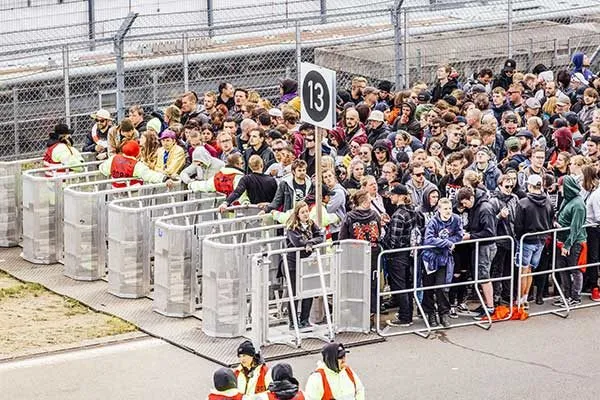
A 30,000-person festival has only one primary scanning point to “simplify” security staffing.
-
The Error: Failing to calculate the “Peak Arrival Rate.” When 15,000 people arrive at once, the queue stretches for two miles.
-
The Outcome: Fans jump the fences out of frustration, the scanner network crashes due to over-capacity, and the event loses 20% of its ticket revenue to “Gate Crashers.”
-
The Strategic Failure: Ignoring the “Throughput Capacity” of the physical architecture.
Planning, Cost, and Resource Dynamics
The economics of event failure are asymmetric. A $5,000 mistake in the planning phase can result in a $500,000 loss during the execution phase.
Estimated “Error Magnification” Table
| Resource | Planning Phase Cost | “On-Site Fix” Cost | Emergency Failure Cost |
| Generator Power | $2,000 (Correct sizing) | $10,000 (Add’l rental) | $150,000 (Full blackout) |
| Flooring/Roads | $15,000 (Pre-order) | $45,000 (Emergency) | $500,000 (Mud-out) |
| Security Staff | $30/hr (Vetted) | $90/hr (Last minute) | $1M+ (Liability/Lawsuit) |
| Sanitation | $10,000 (Audit-based) | $25,000 (Pumping) | Event Shutdown (Permit) |
The Opportunity Cost of “DIY”: Many independent organizers believe they can save money by having their core team handle “Site Management.” However, the opportunity cost is the loss of “Strategic Oversight.” When the Lead Producer is busy fixing a broken fence, they are not monitoring the “Pulse” of the crowd or the “Health” of the budget.
Tools, Strategies, and Support Systems
-
Digital Site Simulations: Using CAD and LiDAR data to run “Evacuation and Flow” tests before a single stake is driven into the ground.
-
Telemetry-Driven Power: Smart generators that report real-time fuel burn and phase-load, allowing for proactive adjustments before a breaker trips.
-
Parametric Insurance: Policies that payout automatically based on data (e.g., wind speed or rainfall) rather than requiring a months-long adjustment process.
-
Unified Command Centers (UCC): A physical space where all leads (Police, Medical, Production) share the same “Live Map” and radio frequency.
-
Real-Time Crowd Heatmaps: Utilizing anonymized Wi-Fi or RFID data to see where density is reaching Level E (dangerous) thresholds.
-
“Red-Team” Audits: Hiring an external firm to “stress-test” the security and logistics plan, looking for the “holes” in the Swiss Cheese.
-
Automated Incident Logs: Ensuring every minor glitch is recorded to identify “Compounding Risk” before it results in a major failure.
Risk Landscape and Failure Modes
-
The “Digital Deadzone”: Failing to install a dedicated private Wi-Fi network for the production team. When the crowd arrives and saturates local towers, the organizers lose the ability to communicate with their own staff or process credit card payments.
-
The “Rider Trap”: Ignoring the “Technical Rider” requirements for artists until they arrive on site. This leads to expensive, last-minute equipment rentals and “Rush Freight” charges that can destroy the project’s margin.
-
The “Fatigue Cascade”: Planning a build schedule that requires crew members to work 18-hour days. Fatigue leads to a decrease in “Situational Awareness,” which leads to the technical errors that cause stage accidents.
Governance, Maintenance, and Long-Term Adaptation
-
The “T-Minus” Countdown Hierarchy: Establishing clear “Go/No-Go” dates for critical infrastructure. If the water supply isn’t certified by T-Minus 24 hours, the event is paused.
-
The “Post-Event Hot Wash”: A mandatory, blame-free review where every department lead identifies what “nearly failed.” This is the only way to avoid repeating mistakes in the next cycle.
-
Vendor Stewardship: Maintaining a “Damage Ledger” for all rented equipment. Returning gear in poor condition leads to higher “Risk Premiums” from vendors in the following year.
Measurement and Evaluation Metrics
-
“Egress Velocity”: The speed at which the site can be cleared. A successful plan should clear the main area in under 30 minutes for every 10,000 attendees.
-
“Queue-to-Entry” Time: If the average attendee is waiting more than 45 minutes, the ingress architecture has failed.
-
“N+1 Reliability”: The percentage of critical systems that have a secondary, hot-swappable backup ready.
Common Misconceptions
-
“The audience won’t notice a small mistake.” In 2026, the audience has a “HD Perspective” and an “Instant Microphone.” Every mistake is noticed and shared.
-
“Experience is better than a plan.” Experience is a tool for executing a plan, not a substitute for one.
-
“Insurance covers everything.” Most policies have strict exclusions for “Poor Planning” or “Foreseeable Negligence.”
-
“More staff equals more control.” An over-staffed site with poor communication is more dangerous than a lean site with clear hierarchies.
-
“Sustainability is a ‘visual’ add-on.” Sustainability is a core operational requirement. Improper waste management can lead to permanent bans from venue sites.
-
“Weather is an ‘Act of God’.” Weather is a “Metric.” If you haven’t planned for a 1-in-10-year storm, you haven’t planned.
Conclusion
The identification and mitigation of common festival planning mistakes is the hallmark of a mature production. As the industry moves further away from the amateurism of the past, the “Resilient Producer” is the one who treats the festival as a high-fidelity system of systems. By respecting the “Hydraulic Effect” of costs, prioritizing the “Last-Mile” logistics, and building a governance model that accounts for human fatigue and technical failure, we ensure that the event remains a celebration of culture rather than a cautionary tale of logistics.