How to Manage Festival Crowds: The 2026 Definitive Safety Guide
How to manage festival crowds. The management of human density in a festival environment is an exercise in fluid dynamics and psychological architecture. When thousands of individuals converge upon a single geographic point, the collective behavior of the mass ceases to be a mere sum of individual choices and instead becomes a systemic force. This force, if left unguided, possesses a natural entropy that leads toward congestion, frustration, and, in extreme cases, physical danger. For the event professional, success is not defined by the absence of a crowd, but by the transformation of that crowd into a coherent, moving, and safe ecosystem.
In the 2026 landscape, the technical requirements for crowd safety have undergone a fundamental shift toward “Predictive Modeling.” The industry has moved beyond the reactive “see-and-respond” tactics of the previous decade. We now operate in an era where high-fidelity spatial data, real-time telemetry, and behavioral science intersect. Managing a crowd today requires an understanding of “Ingress Rhythms,” “Pit Pressure Metrics,” and “Cross-Flow Interference.”
The complexity of this discipline is compounded by the “Experience Expectation” of the modern attendee. The contemporary festival-goer is highly sensitive to friction—long queues for sanitation, aggressive security cordons, or “dead-ends” in site navigation are viewed as failures of the brand.
This definitive reference deconstructs the essential components of high-capacity crowd strategy. By analyzing the historical shift from traditional policing to contemporary stewardship, the conceptual frameworks of density control, and the rigorous operational standards required to manage modern human masses, we provide a strategic roadmap for navigating the most challenging environments in the live event industry.
Understanding “how to manage festival crowds”
To master how to manage festival crowds, one must first discard the notion that a crowd is a static object to be contained. This “Desire Line” phenomenon is the primary cause of unplanned bottlenecks. A management plan that fights human instinct is doomed to fail; a plan that harnesses it is resilient.
From a multi-perspective view, crowd management involves three distinct layers:
-
The Structural Layer: This is the physical layout of the site—fence lines, stage placement, and the width of arterial walkways.
-
The Tactical Layer: This involves the deployment of personnel, the use of “Soft Barriers” (like signage or lighting), and real-time communication protocols.
-
The Behavioral Layer: This is the psychological state of the crowd.
The risk of oversimplification in this field often centers on the “Security Fallacy.” Many organizers believe that increasing the number of security guards is the primary solution to crowd issues.
Contextual Background: The Evolution of Crowd Science
The history of crowd management is a transition from “Public Order” to “Crowd Stewardship.” In the late 20th century, the approach was largely paramilitary, focused on “Containment and Control.” This era was characterized by heavy fencing, aggressive front-of-stage barriers, and a reactive stance toward crowd behavior. High-profile tragedies in the 1990s and early 2000s served as a grim catalyst for a systemic overhaul of these methods.
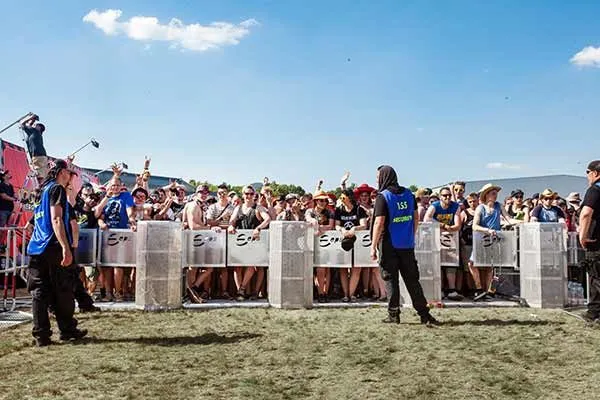
The “Maturity Era” of the 2010s introduced the concept of “Dynamic Risk Assessment.” Researchers began to study “Fruin’s Levels of Service,” which provided a mathematical basis for understanding how many people can safely occupy a square meter before “Turbulence” occurs. This period also saw the introduction of the “T-Bar” and “Primary Curve” barriers, which were designed to dissipate pressure in a “Crush” event.
By 2026, we have entered the “Integration Era.” Crowd management is now a multi-disciplinary field involving data scientists, behavioral psychologists, and structural engineers. We utilize “Digital Twins” to run thousands of simulations of a site before the first fence is staked. The focus has shifted from “Preventing a Riot” to “Optimizing a Flow,” recognizing that safety and satisfaction are inextricably linked.
Conceptual Frameworks and Mental Models
1. The “Fruin Density Scale”
This is the foundational metric for crowd safety. It categorizes density from Level A (free movement) to Level F (complete congestion with high risk of physical harm). A premier management plan aims for a “Level C” average, ensuring that while the site feels “busy,” individuals still have the “Spatial Agency” to change direction without physical contact.
2. The “DIM-ICE” Risk Model
Developed by Dr. Keith Still, this model looks at three phases of an event: Ingress, Circulation, and Egress. For each phase, it audits the Design (the physical site), the Information (how the crowd knows what to do), and the Management (the staff and procedures). If all three are aligned, the risk is minimized.
3. The “Crowd Paradox” of Transparency
This mental model suggests that the more information you give a crowd, the more predictable they become. If a crowd knows that a specific exit is closed or that a stage is at capacity before they reach it, they will self-correct their path. Silence from the organizer creates “Anxiety-Driven Movement,” which is erratic and dangerous.
Key Categories of Crowd Management Systems
Managing a 50,000-person crowd requires different tactical systems working in parallel.
| System Category | Primary Objective | Key Component | Trade-off |
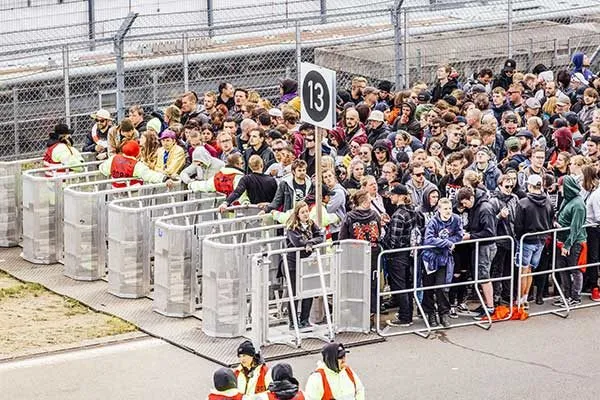
| Ingress Management | Metered arrival to prevent gate crushing. | Serpentine queuing; pre-check zones. | Slower entry; requires high labor. |
| Front-of-Stage (FOS) | Pressure dissipation in high-energy zones. | “Mojo” barriers; T-bar configurations. | Reduces floor space; sightline issues. |
| Arterial Flow | Maintaining movement between stages. | One-way systems; “Keep Clear” zones. | Longer walking distances for fans. |
| Sanitary & Service Buffers | Preventing queues from blocking walkways. | “Offset” placement of toilets/bars. | Increased infrastructure footprint. |
| Egress Extraction | Rapid, safe exit following headliner. | Staged lighting; PA announcements. | High localized traffic congestion. |
Detailed Real-World Scenarios
Scenario A: The “Pulse Surge” at the Main Stage
A popular artist finishes their set, and 20,000 people immediately attempt to move toward the second stage.
-
The Logic: The plan uses “Counter-Flow Separation.” A physical or soft barrier divides the main walkway, forcing the exiting crowd into a “One-Way” stream.
-
The Outcome: By preventing the two opposing flows of people from colliding, the “Velocity of Flow” remains high, and the transition is completed in 15 minutes instead of 45.
Scenario B: The “Gate Failure” during Peak Ingress
A technical issue slows down the scanning of digital tickets, causing a massive backup at the main entrance.
-
The Logic: Utilizing “Pressure Valves”—pre-arranged overflow pens that hold the crowd before they reach the actual turnstiles.
-
The Strategic Adaptation: The plan calls for “Customer Experience” staff to enter the queue with water and megaphones to provide real-time updates, lowering the “Temperature” of the crowd while the IT issue is resolved.
Planning, Cost, and Resource Dynamics
The “Budget for Safety” is often a hidden cost that organizers underestimate.
Estimated Resource Requirements (10,000 Attendees)
| Resource | Quantity/Ratio | Cost Impact | Critical Function |
| Crowd Stewards | 1 per 100 – 250 | High (Labor) | Directional guidance; soft intervention. |
| Licensed Security | 1 per 100 | Moderate | Ejection; incident response; gate control. |
| Fencing/Barriers | 2,000+ Meters | Moderate | Route definition; FOS safety. |
| Signage (Directional) | 50+ High-Vis units | Low | Reducing “Information Friction.” |
| CCTV/Telemetry | Site-wide coverage | High (Tech) | Identifying “Hot Spots” in real-time. |
The “Cost of Friction”
If a site is poorly designed, it requires more labor to manage. A well-designed site with intuitive flow might require 20% fewer stewards because the crowd “manages itself” through the architecture. The “Up-front” investment in CAD planning and professional site design is almost always offset by the reduction in “Crisis Labor” during the event.
Tools, Strategies, and Support Systems
-
LiDAR & Camera Analytics: Using computer vision to count heads per square meter in real-time, triggering “Alerts” when density exceeds 4 people/sqm.
-
Dynamic Wayfinding: Digital LED signage that can change its message based on current flow (e.g., “Use North Exit – 5 min walk” vs. “South Exit Busy”).
-
Pit Communication Systems: Specialized headsets for the “Pit” crew that are isolated from the general security channel, allowing for rapid communication during a “Surge.”
-
“Soft” Stewardship: Using staff in bright, non-threatening colors (Yellow/Purple) rather than “Tactical Black” to lower the psychological intensity of the gate.
-
Acoustic Crowd Management: Using specific frequencies or PA announcements to “Pulse” a crowd into moving at a specific pace.
-
RFID “Heat Mapping”: Tracking anonymized movement data via wristbands to identify which concessions or stages are becoming “Over-Saturated.”
Risk Landscape and Failure Modes
-
The “Compression Wave”: In high-density crowds, a single person falling can cause a “Dominos” effect. This is usually caused by a lack of “Internal Barriers” in the middle of a large field.
-
“Cross-Flow Intersections”: When two major paths cross at a 90-degree angle. This is the highest-risk point for a total “Lock-up” where no one can move in any direction.
-
The “False Exit” Syndrome: Crowds will instinctively head for the gate they entered through. Plans must include “Egress-Only” gates that are 3x the width of entry gates.
Governance, Maintenance, and Long-Term Adaptation
-
The “Hourly Sync”: A mandatory 15-minute meeting between the Event Director, Head of Security, and Medical Lead to review “Flow Trends” and adjust staffing.
-
Post-Event “Hot Wash”: Analyzing the CCTV footage and the RFID data to see where the site “Broke”—where did people jump fences? Where did they congregate unexpectedly?
-
Adaptive Site Maps: Never using the exact same map twice. Every year, the stage placements and bar locations should be tweaked based on the previous year’s “Friction Data.”
Measurement, Tracking, and Evaluation
-
“Time to Clear Stage”: How many minutes after the final note until the FOS area is at Level A density?
-
“Incident-to-Response” Time: The duration between a “Spotter” identifying a crowd issue and a steward arriving to manage it.
-
“Density Delta”: The difference between the “Predicted” density in the CAD model and the “Actual” density recorded by cameras.
Common Misconceptions
-
“Barriers make it safer.” Not always. Too many barriers can create “Dead-Ends” and “Trap Zones.”
-
“Signage is enough.” Humans rarely read signs in a crowd. They look at the back of the head in front of them and the “Visual Anchor” (the stage/exit) in the distance.
-
“Crowds are aggressive.” Most crowd issues are caused by “Logistical Panic,” not malice.
-
“More guards = more safety.”
-
“Egress happens naturally.” Egress is the most dangerous part of any event and requires the most active management.
-
“The ‘Pit’ is the only dangerous spot.” The “Secondary Wave” (the people 20 rows back trying to move forward) is often where the most pressure builds.
Conclusion
The art of how to manage festival crowds is a balance of “Hard Science” and “Soft Grace.” As festivals grow larger and more complex, the industry’s ability to move masses of people safely will remain the ultimate benchmark of professional competence. A successful event is one where the attendee feels a sense of total freedom, unaware of the “invisible architecture” that ensured they were never truly in danger. We are not just managing bodies; we are stewarding the “Collective Joy” of the crowd.