Top Event Production Plans: The 2026 Definitive Systems Guide
The production of a large-scale event in 2026 is no longer an exercise in mere logistics; it is an exercise in systems engineering. As the boundary between physical presence and digital integration continues to dissolve, the complexity of managing live environments has scaled exponentially. What was once a linear path from “load-in” to “curtain up” is now a multi-dimensional matrix of technical redundancies, data security protocols, and human-centric design. For the executive producer, the challenge is not just the execution of a singular moment, but the governance of a temporary city that must function perfectly for a defined window of time.
In this landscape, the structural integrity of a project depends entirely on the sophistication of its underlying blueprints. A high-level plan is not a static document; it is a living framework that must account for meteorological volatility, fluctuating supply chains, and the increasing technical demands of a high-bandwidth audience.
The evolution of the industry has moved toward a “Zero-Lag” operational model. This requires a shift from reactive problem-solving to predictive modeling. Whether it is a global product launch, a complex industrial summit, or an immersive cultural festival, the standard of excellence is now defined by the “Invisibility of Tech”—the seamless synchronization of light, sound, and logistics so precise that the attendee perceives only the experience, never the machinery behind it.
This definitive reference deconstructs the essential components of elite-tier event strategy. By analyzing the historical shift from theater to immersive tech, the conceptual frameworks of risk mitigation, and the rigorous operational standards required to manage modern crowds, we provide a strategic roadmap for navigating the highest tier of live experience production.
Understanding “top event production plans”
To define the top event production plans, one must move beyond the “checklist” mentality and view the plan as a modular architecture. A common misunderstanding among mid-level planners is the belief that a plan is a set of instructions. In reality, a premier production plan is a “Logic Tree”—a series of if/then statements that provide a pre-authorized path for every conceivable deviation from the baseline. If the primary video server fails, the plan does not call for a meeting; the plan triggers a sub-routine where the secondary server has already assumed the load with zero frame-loss.
From a multi-perspective view, a production plan is judged by its “Information Density.” A high-tier plan includes detailed CAD (Computer-Aided Design) overlays, frequency coordination maps for wireless audio, and minute-by-minute “Show Flows” that synchronize the front-of-house experience with back-of-house logistics. The risk of oversimplification occurs when planners focus on the “What” (the stage design, the catering) rather than the “How” (the power distribution, the egress rates, the internal communications latency).
Furthermore, we must address the “Psychological Architecture” of the plan. A top-tier document accounts for the human factor—not just the attendee’s journey, but the crew’s operational fatigue. It builds in “Rest-Rotation” cycles and “Communication Buffers” to ensure that the people operating the technical systems are as resilient as the hardware itself. In 2026, the best plans are those that treat human bandwidth as a finite, mission-critical resource.
Contextual Evolution: From Proscenium to Immersive Ecosystems
The history of event production is a narrative of “Expanding the Frame.” This was the era of “Fixed Perspective.”
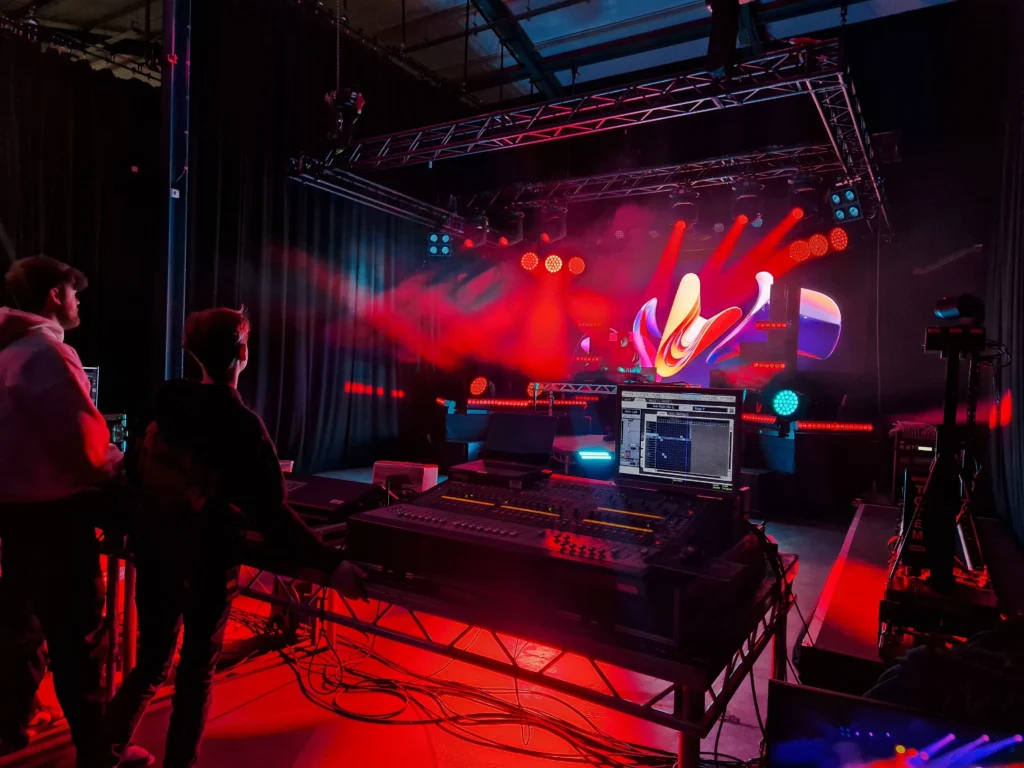
The late 20th century introduced the “Broadcast Era,” where events were designed primarily for the camera lens. This required a systemic shift in lighting design (to accommodate color temperature) and audio engineering (to manage the “Home” vs. “Room” mix). Production plans became significantly more complex, incorporating satellite uplinks and the early stages of computerized show control.
By 2026, we have entered the “Spatial Era.” The event is no longer something you watch; it is something you inhabit. This shift is powered by “Real-Time Rendering” (using engines like Unreal) and “Spatial Audio” (object-based mixing). Modern top event production plans must now govern 360-degree environments where the “Front of House” is everywhere. This evolution has moved the role of the producer from a “Stage Manager” to a “Systems Architect,” responsible for the integration of physical structures with persistent digital layers.
Conceptual Frameworks and Mental Models for Production
1. The “Single Point of Failure” (SPF) Audit
This framework requires the production team to isolate every component of the show—from the main power tie-in to the specific laptop triggering the opening video—and ask: “If this breaks, does the show stop?” A premier plan ensures that for every “Critical Node,” there is a redundant “Shadow System” running in parallel.
2. The “Attendee Energy” Curve
Rather than just a timeline of sessions, this mental model maps the physiological and psychological state of the guest. It accounts for “Cognitive Load”—scheduling high-intensity technical reveals when energy is high and contemplative, low-stimulus content during “Post-Prandial” (after lunch) dips.
3. The “Logistical Latency” Framework
This framework measures the time it takes for a resource to move from “Standby” to “Deployment.” The goal of a high-tier plan is to reduce this latency to near-zero through decentralized decision-making.
Key Categories of Production Plans
The diversity of the 2026 event landscape requires specialized “Plan Archetypes” based on the primary objective of the gathering.
| Category | Typical Use Case | Standout Feature | Major Trade-off |
| High-Bandwidth Hybrid | Product Launches | 4K Broadcast + Live Sync. | Extreme technical cost; dual-mix complexity. |
| Immersive Experiential | Brand Activations | 360° Projection; Spatial Audio. | Low capacity; high per-head cost. |
| Industrial Scale | Trade Shows / Summits | Modular “Plug-and-Play” Booths. | Generic aesthetic; high logistical volume. |
| Tactical Boutique | Executive Retreats | Ultra-high security; personalized tech. | No “Economy of Scale”; high-touch labor. |
| Cultural Festival | Multi-day Outdoors | Temporary “City” Infrastructure. | Weather dependency; high “Duty of Care.” |
Detailed Real-World Scenarios
Scenario A: The “Zero-Latency” Global Keynote
A tech giant launches a new OS across three cities simultaneously.
-
The Logic: The production plan utilizes a “Global Master Clock” to sync light and sound across thousands of miles.
-
The Decision Point: A primary fiber link in the London hub goes down ten minutes before the “Go” signal.
-
The Outcome: Because the plan included a “Satellite Shadow,” the system automatically switched to the secondary uplink. The audience perceived no change; the production team only saw a “Status: Yellow” on their dashboard.
Scenario B: The “High-Stakes” Outdoor Multi-Day
A mountain-top luxury automotive launch in Colorado.
-
The Logic: Prioritizing “Meteorological Resilience.” The stage is built to withstand 80mph gusts, and the lighting rig uses IP65-rated (waterproof) gear.
-
The Failure Mode: Ignoring “Altitude Hypoxia” for the crew.
-
The Strategic Adaptation: The plan was adjusted on Day 2 to include “Oxygen Buffers” in the production office and longer “Load-In” windows to prevent crew burnout in the thin air.
Planning, Cost, and Resource Dynamics
The financial management of a top-tier event is a study in “Risk-Adjusted Budgeting.”
Estimated Cost Allocation for Premier Productions (2026)
| Expense Item | Percentage | Primary Variable |
| Technical AV/Stage | 35% – 45% | Resolution (4K vs 8K) & LED Pitch. |
| Logistics & Labor | 20% – 25% | Union vs Non-Union & Local vs Travel. |
| Content Production | 15% – 20% | Pre-rendered vs Real-time interactive. |
| Venue & Infrastructure | 10% – 15% | Greenfield (empty site) vs Built-in. |
| Contingency Fund | 5% – 10% | Weather/Supply Chain Risk. |
The Opportunity Cost of “Budget Optimization”
A common error is cutting the “Redundancy” line item to save 5% of the total budget. However, if a $10,000 server prevents the failure of a $2,000,000 event, the “Effective Cost” of that server is actually the protection of the entire $2,000,000 asset. High-level production plans prioritize “Uptime” over “Savings.”
Tools, Strategies, and Support Systems
-
Digital Twin Modeling: Using BIM (Building Information Modeling) to walk through the event in VR before a single truss is hung.
-
Encrypted Comms (Clear-Com/Riedel): Multi-channel digital headsets that allow the Lighting Director to talk to the Stage Manager without cluttering the “Global” channel.
-
RFID Crowd Monitoring: Real-time heat maps that allow security to deploy staff to “bottleneck” zones before a crush occurs.
-
Automatic Frequency Coordination: Tools like Shure Wireless Workbench to manage hundreds of wireless mics in crowded RF environments like New York or Las Vegas.
-
Uninterruptible Power Supply (UPS) Arrays: Protecting sensitive digital consoles from “Brownouts” or generator surges.
-
Sustainable Load-In Logistics: Utilizing electric forklift fleets and “Reusable Crating” to meet 2026 ESG (Environmental, Social, and Governance) mandates.
Risk Landscape and Failure Modes
-
Technical Cascading Failure: One bad HDMI cable can freeze a switcher, which stops the video, which kills the “vibe” and stops the show. This is prevented by “Input Isolation.”
-
The “Social Media” Risk: A technical glitch in 2026 is amplified instantly by thousands of attendees. The plan must include a “Digital Crisis Response” to manage the narrative within seconds of an incident.
-
Cyber-Interference: High-profile events are targets for “Wi-Fi Jamming” or unauthorized drone incursions. Top plans include “RF Shielding” and “Counter-UAS” (Unmanned Aerial Systems) strategies.
Governance, Maintenance, and Long-Term Adaptation
Stability in large-scale production is maintained through a “Tri-Layer” review system.
-
The “T-Minus” Review: Daily briefings starting 90 days out, moving to hourly briefings 48 hours before the event.
-
The “Hot-Wash” Debrief: An immediate, raw review of what worked and what failed within 24 hours of “Load-Out.”
-
The “Legacy Repository”: Archiving CAD files, “Show Files,” and frequency maps for future iterations to ensure “Institutional Knowledge” is not lost when crews change.
Measurement, Tracking, and Evaluation
-
Leading Indicator: “Load-In Velocity”—are we hitting our rig-points on schedule? If we are 2 hours behind on Day 1, we will be 8 hours behind on Day 3.
-
Lagging Indicator: “Net Promoter Score” (NPS) specifically regarding the “Environmental Comfort” (temp, sound, flow).
-
Qualitative Signal: “Crew Cohesion”—are the technical departments collaborating or “siloing” during a crisis?
Common Misconceptions
-
“High-tech is the same as high-quality.” A $5M LED wall is useless if the content is poorly paced or the audio is unintelligible.
-
“Wireless is better.” In high-stakes production, “Hard-Wired is King.” If it doesn’t need to move, it should be plugged in.
-
“The venue handles the power.” Never assume. Always bring your own “Power Distribution” (Distro) to ensure clean, isolated ground.
-
“A bigger crew is safer.” Excess labor creates “Operational Friction.” A lean, elite crew with clear “Comms Chains” is always superior.
-
“The plan is finished on Day 1.” The plan is finished when the last truck leaves the venue.
Conclusion
The pursuit of the top event production plans is a commitment to the “Philosophy of Readiness.” In an age of infinite digital distraction, the live event remains the most powerful tool for human connection and brand storytelling, but its complexity has left no room for the amateur. The modern producer must be a hybrid—part architect, part engineer, part psychologist. By adhering to the principles of “Redundancy,” “Latency Reduction,” and “Systems Governance,” we can create environments that are not just technically flawless, but emotionally resonant. The machinery should be invisible; the impact should be permanent.